
Tips · July 29, 2026 · 8 min read · by Captain Thierry
How to Cook Your Catch: 3 Creole Fish Recipes from Martinique
You'll head home from your trip with 4–7 lb (2–3 kg) of fish per angler. Here's how Martinicans have always cooked it, with the classic Creole fish recipes: trempage (the marinade), court-bouillon (fish simmered in tomato sauce), blaff (fish poached in a clear, aromatic broth) and sauce chien (a lime, herb and hot pepper sauce).
It's the moment many of our guests love most: in the evening, out comes the cooler, the day's catch gets cut up, and the house fills with the scent of lime, garlic and bois d'inde (West Indian bay leaf).
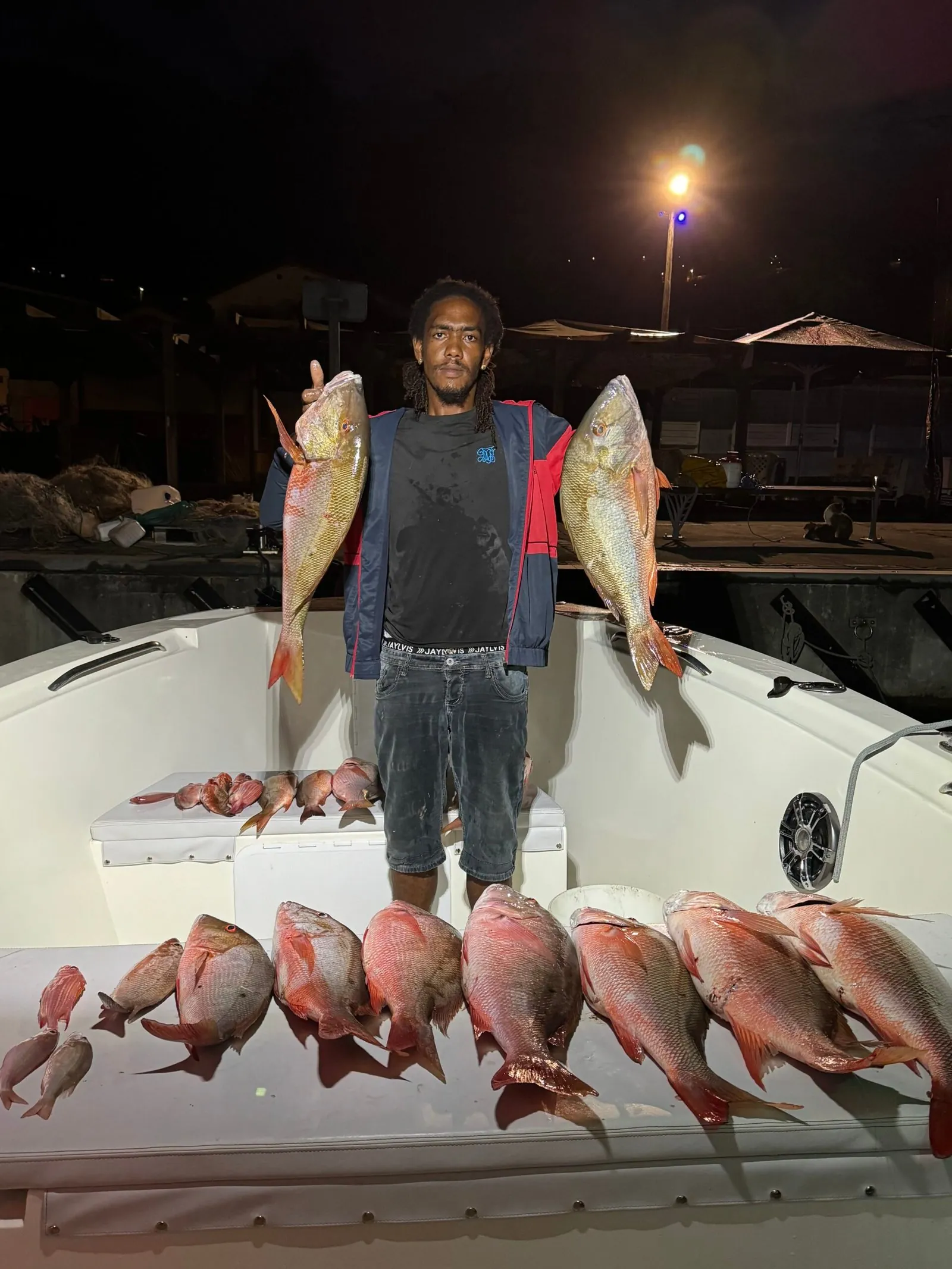
A fishing trip in Martinique doesn't end at the dock. With Carib Évasion, you take home your share of the catch — on average 4–7 lb (2–3 kg) of fresh fish per angler. That's enough to feed the whole table the same night.
Of course, you still need to know what to do with it. Here are the three essential Creole dishes, cooked the way we make them here, along with the step nobody ever skips: trempage.
Trempage: the step nobody skips
Before any recipe comes trempage — the Creole marinade. It's what gives West Indian fish its unmistakable flavor.
Start by “liming” the fish: rub it generously with a cut lime, then rinse. Next, make the marinade:
- Juice of 3 to 4 limes
- 3 garlic cloves, crushed
- Salt and pepper
- A little hot pepper (go easy: the local Scotch bonnet-type pepper doesn't mess around)
- Optional: a little finely chopped cive, the local green onion
Coat the fish and let it rest in the fridge for 20 to 30 minutes. The flesh firms up and takes on flavor, and everything that follows is better for it. Don't leave it much longer: the lime starts to “cook” the fish if you forget about it.
Recipe 1 — Creole fish court-bouillon
The ultimate Sunday dish. Despite its name, Creole court-bouillon is nothing like a plain broth: it's fish simmered in a fragrant tomato sauce, served with white rice.
Serves 4
- 2.6 lb (1.2 kg) firm-fleshed fish, cut into steaks (snapper, mutton snapper, porgy)
- 2 onions, 3 garlic cloves, 3 cives (green onions)
- 4 ripe tomatoes (or 2 tablespoons tomato paste)
- Thyme, parsley, 1 bois d'inde leaf, 2 whole cloves
- 1 Scotch bonnet-type pepper (left whole, not pierced)
- Oil, salt, pepper, 1 lime
Method
- Marinate the fish (trempage) as described above.
- In a Dutch oven, cook the sliced onions, garlic and cives in oil until lightly browned: this is the “roussi.”
- Add the chopped tomatoes, thyme, parsley, bois d'inde and cloves. Let it cook down for 5 minutes.
- Add a large glass of water, season with salt and pepper, then drop in the hot pepper whole (it adds flavor without the burn as long as it stays intact).
- Gently lay the fish steaks in the sauce. Cover and cook over low heat for 12 to 15 minutes. Don't stir: shake the pot instead.
- Remove the pepper, add a squeeze of lime and serve right away with white rice.
Recipe 2 — West Indian blaff
Legend has it the name comes from the sound of the fish dropping into the simmering broth. Blaff is the exact opposite of court-bouillon: light, clear and packed with aromatics. It's the perfect recipe when the fish is ultra-fresh — which makes it ideal right after a trip.
Serves 4
- 2.6 lb (1.2 kg) fish, whole and gutted or cut into chunks
- 1 onion, 4 cives, 3 garlic cloves
- Thyme, parsley, 1 bois d'inde leaf, 3 whole cloves
- 1 whole hot pepper, salt, whole peppercorns
- 2 limes
Method
- Marinate the fish (trempage) for 30 minutes in the fridge.
- Bring 6⅓ cups (1.5 liters) of water to a boil with the onion, cives, garlic, thyme, parsley, bois d'inde, cloves, peppercorns and the whole hot pepper. Let it simmer for 10 minutes: the broth should be very fragrant.
- Drop the fish into the simmering broth (the famous “blaff!”).
- Poach for 5 to 10 minutes, depending on thickness, without ever letting it reach a rolling boil, or the flesh will fall apart.
- Serve the fish in a little of its broth, drizzled with lime juice, alongside rice or root vegetables (yam, sweet potato).

Recipe 3 — Grilled fish with sauce chien
This is the recipe for the big catches. Yellowfin tuna, wahoo and mahi-mahi (dorado) have dense, flavorful flesh that's made for the grill. Serve it with the must-have sauce chien, the island's national condiment.
Grilling the fish
- Cut the fish into steaks ¾ to 1¼ inches (2–3 cm) thick.
- Marinate for 30 minutes in lime juice, crushed garlic, oil, thyme, salt, pepper and a little hot pepper.
- Sear on a very hot grill: 3 to 4 minutes per side. Tuna is best left pink in the center; wahoo, which is firmer, can take a little more cooking.
Sauce chien (5 minutes)
Despite its curious name (chien means “dog” in French), there's obviously no dog in it. As for where the name comes from, the local explanations vary and the true origin has been lost.
- 1 onion, 4 cives, 3 garlic cloves and a bunch of parsley, all very finely chopped
- Salt, pepper and hot pepper to taste
- Juice of 2 limes, 2 tablespoons oil
- 1 small glass of boiling water, poured over at the last minute
Stir and let it sit for 10 minutes. Spoon it over the grilled fish just before serving. With ti-nains (green bananas) or a christophine (chayote) gratin, it's West Indian cooking at its simplest.
Creole fish recipes: which fish for which dish?
Every species has its go-to preparation:
- Snapper, mutton snapper, porgy, grunt (firm, delicate flesh; inshore fishing) → court-bouillon or blaff.
- Yellowfin tuna, wahoo, mahi-mahi (dense flesh; deep-sea fishing) → grilled, as tartare or as pan-seared steaks.
- Jack (rich, full-flavored flesh) → grilled or in a well-spiced court-bouillon.
- Bigeye scad (goggle-eye) and other small fish → fried whole, as an appetizer.
To find out exactly what's in your cooler, check our guide to Martinique fish species: it covers the 20 species you'll come across here, with their size, season and fishing technique.
How to keep your catch fresh
Even the best fish will ruin a meal if it's poorly stored. Follow a few simple rules:
- Bring a cooler with ice for the drive home: it's the one habit you really can't skip.
- Gut and scale the fish quickly — ideally within a few hours.
- Keep it in the fridge and try to eat it within 24 to 48 hours.
- After that, freeze it in portions, well wrapped or vacuum-sealed, with the steaks kept separate.
A word on safety: depending on the area, some reef species can carry ciguatera (a type of fish poisoning). That's where the captain comes in: he sorts the catch and keeps only what's safe to eat. That's the kind of local knowledge you can't fake.
From line to plate
Maybe that's the real luxury of a trip on the water in Martinique: sitting down in the evening to a fish you watched come out of the water that morning, cooked from a recipe handed down for generations.
Want the full experience, start to finish? Book a family inshore fishing trip or an offshore deep-sea fishing trip — and don't forget the cooler. Our beginner's checklist tells you everything you need to bring.
Book your trip online or call Captain Thierry at +596 696 40 56 21. He'll also share his version of court-bouillon. Every family has its own.
Your fish, caught that same morning
You take home your share of the catch: 4–7 lb (2–3 kg) of fresh fish per angler.